
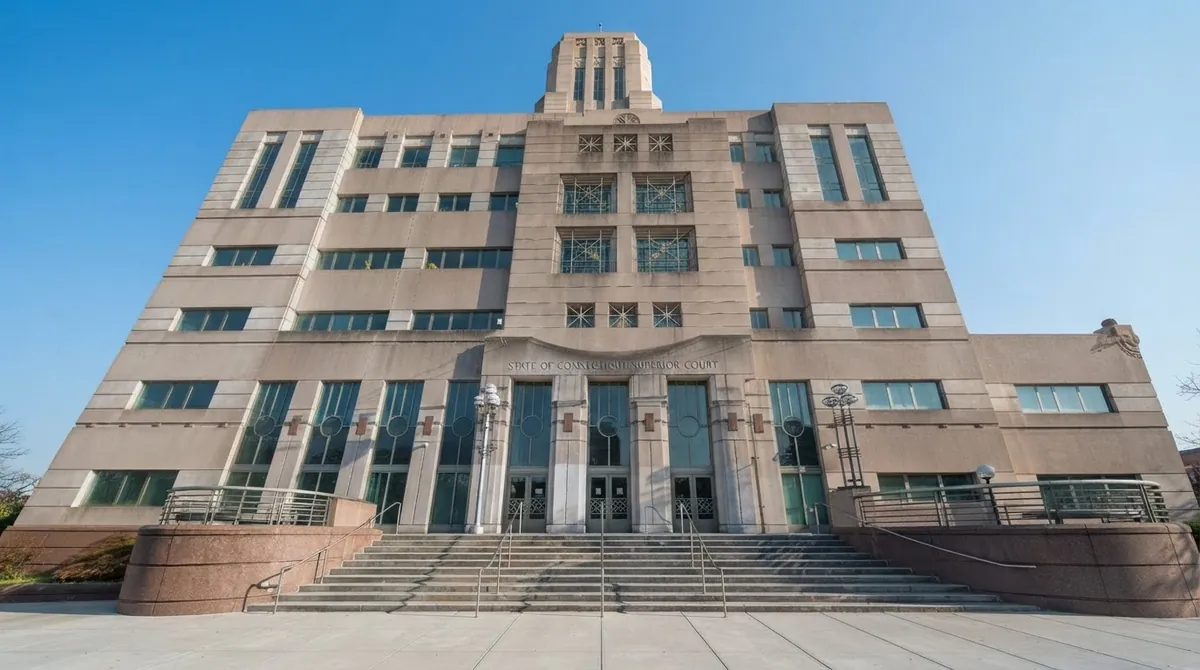
Middlesex County court records in the state of Connecticut are maintained by clerks of the respective courts and are accessible through online portals, official court resources, and directly at the court clerk's office. MiddlesexCourt.us will help you navigate the publicly available court information of this county. Additionally, you can use the Connecticut Judicial Branch portal, the State's Attorney's office in the Middlesex Judicial District, and other state resources.
Middlesex Court System Overview
Middlesex is part of the Middlesex Judicial District within the unified court system of Connecticut. Unlike many other states, Connecticut has abolished county governance, so courts are organized by judicial districts rather than administrative counties. The main court serving this district is the Superior Court in Middletown, which handles criminal, civil, and family cases.
The Middlesex Judicial District includes the towns of Middletown, Chester, Clinton, Cromwell, Deep River, Durham, East Haddam, East Hampton, Essex, Haddam, Killingworth, Old Saybrook, Portland, Westbrook, and others.
The State's Attorney's office for the Middlesex Judicial District is located at:
Courts Serving Middlesex
Residents of Middlesex County may have cases in several courts of different levels. Below are the main ones.
Connecticut Superior Court — Middlesex Judicial District
Handles criminal, civil cases, family law, and housing matters.
Connecticut Probate Court
The Middlesex County is served by several probate courts depending on the town of residence. You can find your court on the official site of Probate Courts Connecticut. Probate courts handle matters of inheritance, guardianship, and conservatorship.
United States District Court for the District of Connecticut
Federal civil and criminal cases involving county residents are heard in this court. Bankruptcy cases are handled by the United States Bankruptcy Court for the District of Connecticut.
What Types of Cases Middlesex Courts Hear
The courts serving Middlesex cover a wide range of cases:
- Criminal cases — felonies, misdemeanors, infractions
- Civil lawsuits — including small claims
- Family law — divorce, child custody, alimony, protective orders
- Probate cases — inheritance, guardianship, conservatorship
- Juvenile matters — delinquency, child protection, adoption
- Traffic violations, including DUI
District Court Cases in Middlesex
In Connecticut, there are no separate district and magistrate courts in the traditional sense. The Superior Court serves as the court of general jurisdiction. In the Middlesex Judicial District, this court hears serious criminal cases, civil lawsuits of any amount, and appeals from administrative agencies.
A criminal case typically begins with an arrest or issuance of a warrant, after which the accused is brought to an arraignment in the Superior Court. A judge is appointed according to the internal distribution of cases. Complex civil cases — such as real estate disputes or contracts for significant sums — are also heard by the Superior Court in Middletown.
Magistrate Court Cases in Middlesex
Connecticut uses a system of Magistrate Judges within the Superior Court for certain categories of cases. Magistrates can conduct preliminary hearings, handle traffic violation applications, and small claims cases.
The limit for small claims in Connecticut is $5,000. Such cases are handled in a simplified manner without mandatory attorney representation. Traffic violation and DUI cases begin with an arraignment and may be referred to a Superior Court judge if the defendant pleads not guilty.
Family Law, Probate, and Juvenile Matters in Middlesex
Family Law. Divorce, custody, alimony, and protective order cases are heard by the Family Division of the Superior Court in Middletown. To obtain a copy of a divorce decree, you should contact the court clerk's office, not the Vital Records Office. For historical divorce records in the county, the Connecticut Divorce Index, 1655–1953 is available.
Probate Cases. Inheritance, guardianship, and conservatorship fall under the jurisdiction of probate courts. Each town in the county has its own Probate Court; contact information and forms can be found on the Connecticut Probate Courts website.
Juvenile Matters. Juvenile Matters are handled by a separate division of the Superior Court. Records in juvenile cases are confidential under Connecticut law.
How Cases Move Through the Middlesex Court System
- Case Initiation. A criminal case begins with an arrest or warrant; a civil case with the filing of a complaint; a family case with a petition.
- Judge Assignment. The case is distributed according to category and judge workload.
- First Hearing. Arraignment in criminal cases, scheduling conference in civil cases.
- Pre-Trial Phase. Motions, discovery, plea negotiations.
- Trial. A jury or judge renders a verdict; in civil cases, a settlement or default judgment is possible.
- Post-Judgment. Sentencing, appeal to the Appellate Court or Supreme Court of Connecticut, enforcement of judgment.
Court Administration, Local Rules, and Public Access in Middlesex
The courts in the Middlesex Judicial District are administered by the Chief Court Administrator through the centralized system of the Judicial Branch of Connecticut. Local court rules (Practice Book) are uniform for the entire state and available on the Judicial Branch website.
According to Connecticut law, most court records are public. Exceptions include juvenile cases, sealed records, and certain family cases. To obtain copies of documents, contact the Superior Court clerk's office in Middletown in person or by mail.
Hearings can be attended in person. In some categories of cases, the Connecticut Judicial Branch allows remote participation via videoconference — check with the court clerk's office.
For information on criminal records, contact the Connecticut State Police or Judicial Branch, as the Division of Criminal Justice does not provide such information directly.
Court Records and Related Court Resources in Middlesex
- Case Search. Online case search is available through the Connecticut Judicial Branch portal (Civil/Family Case Look-up). MiddlesexCourt.us also provides helpful links to start your search.
- Criminal History Check. The State Police Bureau of Identification conducts checks for $75 (state) and $13.25 (federal).
- Police Reports. State Police incident reports can be requested through the Reports and Records page.
- Inmate Search. The Inmate Search of the Connecticut Department of Correction allows you to find individuals in custody. Additional inmate information can be obtained on the DOC's separate page.
- Vital Records. Birth, marriage, and other certificates are issued by the State Vital Records Office. Birth certificates can also be ordered through local registration offices.
- Law Enforcement Resources. A list of Middlesex County police departments and community resources for the Middlesex Judicial District are available on the CT.gov portal.
- Lien and Encumbrance Search. The Lien Records Search by the Secretary of the State covers financial statements, federal tax liens, and court judgments.
- Land Parcels and Property Tax. Parcel information can be found on the CT Geodata Portal, and general property tax questions on the Property Tax page.
- Probate Courts. Forms, instructions, and electronic document submission are available on the Connecticut Probate Courts website.